Anchorage set losses: Difference between revisions
Jump to navigation
Jump to search
No edit summary |
m (Text replacement - "</tex>" to "</math>") |
||
| (7 intermediate revisions by the same user not shown) | |||
| Line 1: | Line 1: | ||
Anchorage set losses are caused by the movement of the tendon prior to seating of the [[wedge|wedges]] or the [[anchorage|anchorage gripping device]]. A common value of these losses is about 10mm (AASHTO LRFD 2007). | |||
< | If <math>\Delta_a</math> is the anchorage slip and <math>L_a</math> is the length along the tendon affected by the anchorage slip (Choudry 1986), then: | ||
where < | <math>\Delta_a = \int_0^{L_a} \Delta_{\epsilon} dx</math> | ||
where <math>\Delta_{\epsilon}</math> is the decrease in the tendon strain due to anchorage slip. | |||
=== Uniform distribution of anchorage losses === | === Uniform distribution of anchorage losses === | ||
Assuming that the anchorage slip losses are uniformly distributed over the entire length of the tendon (in other words < | Assuming that the anchorage slip losses are uniformly distributed over the entire length of the tendon (in other words <math>\Delta_{\epsilon}</math> is constant), then the following equations can be written: | ||
< | <math>\Delta_a = \Delta_{\epsilon} L</math> | ||
< | <math>\Delta_{\epsilon} = \frac{\Delta_a}{L}</math> | ||
Noting that | Noting that | ||
< | <math>\Delta_{\sigma} = E_p \Delta_{\epsilon}</math> and <math>\Delta F = A_p \Delta \sigma</math> | ||
we can write the final equation for the loss of prestress force: | we can write the final equation for the loss of prestress force: | ||
< | <math>\Delta F = A_p E_p \frac{\Delta_a}{L}</math> | ||
where: | where: | ||
* < | * <math>A_p</math> ... area of the prestressing tendon | ||
* < | * <math>E_p</math> ... [[Young's modulus]] of the prestressing tendon | ||
* < | * <math>\Delta F</math> ... loss of prestressing force | ||
* < | * <math>L</math> ... length of the tendon | ||
== References == | |||
* AASHTO LRFD Bridge Design Specifications, SI Units, 4th Edition, 2007; Article 5.9.5.2.1, p. 5-109 | |||
* Deepak Choudry: Analysis of Curved Nonprismatic Reinforced and Prestressed Concrete Box Girder Bridges, Report No. UCB/SEMM-86/13, December 1986; p. 45 (Section 3.4.2: Anchorage Slip Losses) | |||
{{Prestressed Concrete}} | {{Prestressed Concrete}} | ||
Latest revision as of 02:24, 22 October 2024
Anchorage set losses are caused by the movement of the tendon prior to seating of the wedges or the anchorage gripping device. A common value of these losses is about 10mm (AASHTO LRFD 2007).
If is the anchorage slip and is the length along the tendon affected by the anchorage slip (Choudry 1986), then:


where is the decrease in the tendon strain due to anchorage slip.

Uniform distribution of anchorage losses
Assuming that the anchorage slip losses are uniformly distributed over the entire length of the tendon (in other words is constant), then the following equations can be written:


Noting that
and


we can write the final equation for the loss of prestress force:
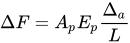
where:
- ... area of the prestressing tendon
- ... Young's modulus of the prestressing tendon
- ... loss of prestressing force
- ... length of the tendon


References
- AASHTO LRFD Bridge Design Specifications, SI Units, 4th Edition, 2007; Article 5.9.5.2.1, p. 5-109
- Deepak Choudry: Analysis of Curved Nonprismatic Reinforced and Prestressed Concrete Box Girder Bridges, Report No. UCB/SEMM-86/13, December 1986; p. 45 (Section 3.4.2: Anchorage Slip Losses)
| Home > Topics > Prestressed Concrete e | |
| Overview | Overview · Hyperstatic forces |
| Prestress losses | Friction losses · Anchorage set losses |
| Miscellaneous | Tendon · Post-Tensioning · Partial prestressing · Restraint moment · Prestressing as action or resistance · Standard prestressed girders · Magnel diagram |
|
|
|
| Related Topics | Reinforced Concrete |