Moment area method: Difference between revisions
Jump to navigation
Jump to search
No edit summary |
m (Text replacement - "</tex>" to "</math>") |
||
| (17 intermediate revisions by 2 users not shown) | |||
| Line 3: | Line 3: | ||
== First Theorem == | == First Theorem == | ||
< | [[Image:Moment area method theorem 1(b).gif|right|frame|Picture illustrating the first theorem]] | ||
'''Theorem 1:''' The change in slope between any two points on the [[elastic curve]] equals the area of the M/EI diagram between these two points. | |||
<math> | |||
\theta_{AB} = {\int_A}^B \frac{M}{EI}\;dx | \theta_{AB} = {\int_A}^B \frac{M}{EI}\;dx | ||
</ | </math> | ||
where | |||
* M moment | |||
* EI flexural rigidity | |||
* <math>\theta_{AB}</math> ... change in slope between points A and B | |||
* A, B ... points on the elastic curve | |||
== Second Theorem == | == Second Theorem == | ||
[[Image:Moment area method theorem 2.gif|right|frame|Picture illustrating the second theorem]] | |||
'''Theorem 2:''' The deviation of the tangent at point B on the | '''Theorem 2:''' The deviation of the tangent at point B on the elastic curve with respect to the tangent at point A equals the "moment" of the <math>M/EI</math> diagram between points A and B computed about point A (the point on the elastic curve), where the deviation <math>t_{A/B}</math> is to be determined. | ||
<math> | |||
t_{A/B} = {\int_A}^B \frac{M}{EI} \bar{x} \;dx | |||
</math> | |||
where | |||
* M moment | |||
* EI flexural rigidity | |||
* <math>t_{A/B}</math> ... deviation of tangent at point B with respect to the tangent at point A | |||
* <math>\bar{x}</math> ... centroid of M/EI diagram measured horizontally from point A | |||
* A, B ... points on the elastic curve | |||
== References == | == References == | ||
* Russel C. Hibbeler: Structural Analysis, 3rd Edition, Prentice Hall, 1995, chapter 8, p. 354-569, ISBN 0-02-354041-9 | * Russel C. Hibbeler: Structural Analysis, 3rd Edition, Prentice Hall, 1995, chapter 8, p. 354-569, ISBN 0-02-354041-9 | ||
== External links == | |||
* [http://www.mathalino.com/reviewer/mechanics-and-strength-of-materials/deflection-of-cantilever-beams-area-moment-method Deflection of Cantilever Beam by Area Moment Method] | |||
* [http://www.mathalino.com/reviewer/mechanics-and-strength-of-materials/deflection-in-simply-supported-beams-area-moment-method Deflection of Simply Supported Beam by Area Moment Method] | |||
* Colin Caprani: [http://www.colincaprani.com/files/notes/SAIII/Mohrs%20Theorems.pdf Structural Analysis III The Moment Area Method – Mohr’s Theorems] (lecture notes), 2007 | |||
{{Traditional Analysis Methods}} | |||
[[Category:Glossary]] | [[Category:Glossary]] | ||
Latest revision as of 03:32, 22 October 2024
The method for finding deflections in a framed structure by use of the moment area curve.
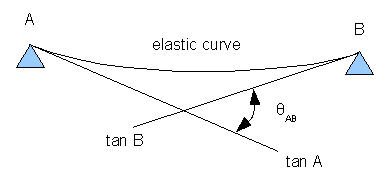
First Theorem
.gif)
Picture illustrating the first theorem
Theorem 1: The change in slope between any two points on the elastic curve equals the area of the M/EI diagram between these two points.
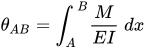
where
- M moment
- EI flexural rigidity
- ... change in slope between points A and B
- A, B ... points on the elastic curve

Second Theorem

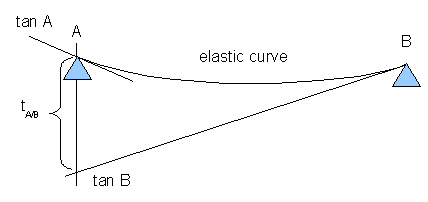
Picture illustrating the second theorem
Theorem 2: The deviation of the tangent at point B on the elastic curve with respect to the tangent at point A equals the "moment" of the diagram between points A and B computed about point A (the point on the elastic curve), where the deviation is to be determined.


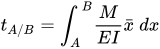
where
- M moment
- EI flexural rigidity
- ... deviation of tangent at point B with respect to the tangent at point A
- ... centroid of M/EI diagram measured horizontally from point A
- A, B ... points on the elastic curve

References
- Russel C. Hibbeler: Structural Analysis, 3rd Edition, Prentice Hall, 1995, chapter 8, p. 354-569, ISBN 0-02-354041-9
External links
- Deflection of Cantilever Beam by Area Moment Method
- Deflection of Simply Supported Beam by Area Moment Method
- Colin Caprani: Structural Analysis III The Moment Area Method – Mohr’s Theorems (lecture notes), 2007
| Home > Topics > Traditional Analysis Methods e | |
| Fundamentals | Traditional analysis methods · Section properties · Mohr's Circle · Interaction diagram |
| Theory | Elasticity equations |
| Forces and Stresses | Torsion · Flexure · Shear · Principal stress |
| Basic Statics | Beam equations · Moment area method · Vereschagin's rule · Stiffness matrix · Fixed end moments · Determinate statics · Indeterminate statics · Maxwell's theorem of reciprocal displacements · Betti's law |
| Influence lines · Muller-Breslau principle | |
| Basic Dynamics | Damping · Mass matrix · Damping matrix |
| Energy Methods | External work and strain energy · Principle of work and energy · Virtual work method · Unit load method · Castigliano's Theorem |
| Approximate Methods | Moment distribution method |
| Graphical | Cremona Diagram |
| See Also | Computational analysis methods |
| Related Categories | Traditional Analysis Methods |